In critical facilities such as data centers, hospitals, and communication rooms, power interruptions are not just inconvenient—they are expensive. At Aokly, we understand that choosing a reliable UPS replacement battery is not only about backup time, but also about long-term operating cost. A well-designed battery reduces maintenance frequency, prevents unexpected downtime, and supports stable system performance over years of service. When users evaluate lifecycle value instead of only upfront price, the financial difference becomes clear.
The Real Cost Behind Frequent Battery Replacement
Many operators focus on initial procurement budgets, yet the hidden expenses of a low-quality UPS replacement battery often appear later. Short service life leads to repeated purchasing, additional labor for installation, and system testing costs. More importantly, unstable discharge performance can increase the risk of backup failure during critical events. Over time, these risks translate into higher operational spending.
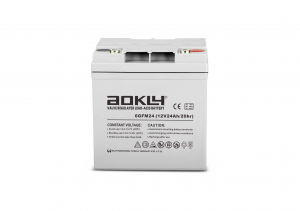
In our experience at Aokly, durability begins with design fundamentals. For example, our 6-GFM-24 series is engineered with a long design life of up to 10 years at 25°C. With a nominal voltage of 12V and a capacity range from 24Ah to 250Ah, it supports a wide variety of UPS applications. The compact structure, low internal resistance, and pasted flat plate design contribute to consistent high-rate discharge performance. These structural details help reduce stress on the system and lower the frequency of battery replacement.
Performance Stability and Maintenance Efficiency
A high-quality UPS replacement battery also minimizes routine maintenance requirements. Self-discharge control plays a key role here. In the 6-GFM-24 series, the self-discharge rate is ≤3% per month, helping systems maintain readiness during storage or standby periods. High sealing reaction efficiency (≥99%) and double terminal sealing technology (mechanical plus epoxy glue) further reduce leakage risk and improve operational safety.
Our company designs products to operate within a wide temperature range from -20℃ to 60℃, which supports installation flexibility in different environments. High assembling pressure increases deep cycle life, while high-strength ABS casing material (UL94-HB, with UL94-V0 optional) enhances structural reliability. These features allow users to reduce inspection frequency and minimize unexpected service interruptions. Over time, maintenance savings accumulate, lowering the total cost associated with each UPS replacement battery deployed.
Lifecycle Value and System Compatibility
When evaluating lifecycle value, compatibility and adaptability also matter. Our systems offer two or more terminal types to meet different installation requirements. Good high-rate discharge performance ensures that power demand spikes can be supported without excessive strain. By selecting a properly specified solution from Aokly, users can match their UPS load profile accurately, avoiding oversizing or premature aging.
Conclusion
High-quality design directly influences long-term operating cost. A carefully engineered UPS replacement battery reduces replacement frequency, stabilizes discharge performance, and lowers maintenance intervention. At Aokly, we focus on structural reliability, temperature adaptability, and sealing integrity so that users can achieve predictable lifecycle expenses. When long-term value is considered alongside technical performance, investing in a dependable battery solution becomes a practical strategy for cost control.