Remote infrastructure projects, island communities, and field monitoring stations often depend on stable power without access to public grids. In these scenarios, a VRLA battery becomes a practical energy storage option because it operates without routine watering and is designed as a sealed system. At Aokly, we understand that off-grid users need reliable backup that can adapt to solar arrays, small wind systems, and hybrid power setups. Rather than focusing only on capacity, we look at temperature tolerance, sealing structure, and discharge characteristics when recommending a VRLA battery for isolated environments.
Why VRLA Technology Fits Off-Grid Conditions
A VRLA battery is valve regulated and typically uses AGM separators to immobilize electrolyte, reducing maintenance and leakage risks. This design is useful in remote locations where technical support may not be immediately available. In solar storage applications, batteries often experience repeated charge and discharge cycles, so internal resistance and heat management matter. With improved AGM separators and compact internal connectors, our systems are structured to maintain lower resistance and stable current flow. These characteristics help users protect sensitive equipment such as communication devices or monitoring instruments installed far from urban centers.
Temperature range is another critical factor. Off-grid systems can face seasonal extremes, so equipment must function between -20℃ and 60℃. Stable sealing efficiency, supported by high reaction efficiency above 99%, contributes to safer operation in enclosed battery cabinets. When paired with renewable charging sources, the controlled self-discharge rate—≤3% per month—also supports long idle periods without rapid energy loss.
Practical Configuration: 6-FM-17 for Field Systems
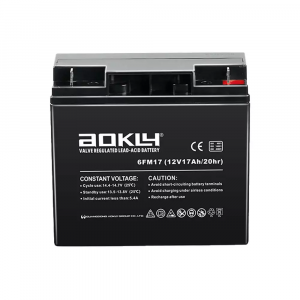
For small-scale remote installations, we often introduce the 6-FM-17 model as a compact 12V solution. This unit provides a nominal capacity of 7Ah and is designed for a 5-year service life at 25℃ under standard conditions. Its pasted flat plate structure and shortened internal connectors reduce internal resistance, supporting good high-rate discharge performance when sudden loads occur.
The casing uses high-strength ABS material (UL94-HB, with UL94-V0 optional), helping it withstand transport and outdoor cabinet integration. Double terminal sealing—mechanical plus epoxy glue—adds structural stability in humid or dusty areas. Multiple terminal types are available, allowing installers to adapt wiring layouts to different off-grid enclosures. These structural features make it suitable for telecom backup, solar lighting systems, and environmental monitoring powered by renewable sources.
System Planning Considerations for Remote Sites
Selecting a battery is only one step in building a dependable off-grid power system. Proper charge controller settings, balanced load calculation, and ventilation planning all influence lifespan. When integrating renewable inputs, installers should match panel output to storage capacity to avoid chronic undercharging. A properly configured VRLA battery can maintain consistent voltage for DC equipment, but oversizing or undersizing the storage bank may shorten service time. At Aokly, we emphasize realistic energy audits and gradual capacity expansion rather than oversized installations that increase cost without proportional benefit.
Conclusion: Reliable Storage for Isolated Power Needs
Using a VRLA battery in remote off-grid locations requires attention to temperature range, sealing structure, discharge behavior, and long-term maintenance planning. Through models such as 6-FM-17, Aokly provides sealed AGM-based solutions that align with renewable systems and small independent power setups. By combining appropriate system design with structurally stable battery units, remote sites can maintain steady energy storage and reduce unexpected downtime.