When power stability matters, choosing the right backup solution becomes essential. At Aokly, we often discuss why a reliable VRLA battery is a practical choice for UPS systems in offices, telecom rooms, and small data facilities. A UPS must respond instantly during outages, and the battery inside determines how smoothly that transition happens. In this article, we explain the top reasons why you need VRLA batteries for UPS applications and how proper battery design directly influences performance, safety, and maintenance requirements.
Stable Backup Performance for Critical Loads
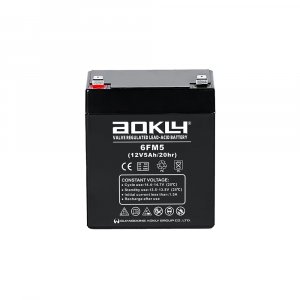
One of the main reasons you need a VRLA battery for UPS is its dependable discharge behavior. UPS systems demand fast high-rate discharge the moment grid power fails. Our 6-FM-5 series is designed with good high rate discharge performance, allowing equipment to continue operating without noticeable interruption. With a nominal capacity range of 4Ah–20Ah and nominal voltage options of 6V and 12V, it adapts to various backup configurations.
For indoor installations, sealed construction is equally important. As a product developed by Aokly, this battery type features a high sealing reaction efficiency of ≥99%, which supports safe operation in enclosed environments. The pasted flat plate design and compact internal structure, including shorter connectors between cells, help reduce internal resistance and improve energy delivery consistency. These structural details explain why a VRLA battery remains a common solution in UPS systems where reliability is required but maintenance access may be limited.
Maintenance Convenience and Long Design Life
Another key reason you need a VRLA battery for UPS lies in its low maintenance nature. Valve regulated lead acid technology minimizes the need for electrolyte replenishment, making daily management simpler for facility teams. Our 6-FM-5 model offers a design life of 5 years at 25°C, supporting medium-term planning without frequent replacements.
Self-discharge is controlled at ≤3% per month under standard conditions, which helps preserve stored energy during standby. The improved AGM separator increases assembling pressure and contributes to lower internal resistance, supporting cycle life under regular UPS testing routines. The casing material uses high strength ABS (UL94-HB), with UL94-V0 available as an option, while double terminal sealing technology combines mechanical structure and epoxy glue to enhance durability. Through these design considerations, Aokly provides solutions that align with practical UPS operating conditions rather than theoretical specifications.
Conclusion
Understanding the top reasons why you need VRLA batteries for UPS helps users make informed choices about backup power systems. From high rate discharge capability and compact internal structure to controlled self-discharge and reliable sealing, a well-designed VRLA battery supports stable UPS performance. At Aokly, we develop solutions such as the 6-FM-5 series to meet these operational needs while balancing safety, lifespan, and maintenance efficiency. For facilities that depend on uninterrupted power, selecting the right battery technology remains a practical and necessary step.